Viehhofen: A Deep Alpine Base with Varied Terrain
Viehhofen combines a substantial vertical drop with a mapped piste network that leans towards blue and red skiing, while still offering a meaningful black-terrain share.

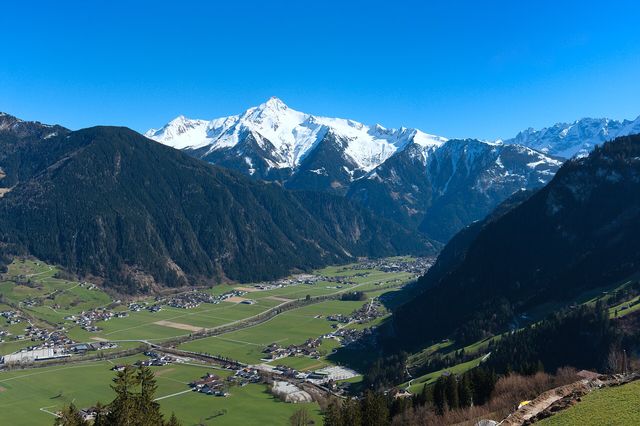
Viehhofen sits in a broad Alpine valley, with the village gathered beneath wooded slopes and higher, more open mountain terrain above. Its character is that of a compact mountain settlement serving skiers who want a direct base rather than a resort built around a single high-altitude bowl. The surrounding landscape moves from forested lower slopes to more exposed upper ground, giving the area a clear sense of progression as the lifts climb. It is a useful setting for exploring a varied ski domain while retaining a village-scale identity.

Alertes de neu gratuïtes
Tria la teva estació. Rep un correu gratuït quan es prevegi una nevada important. Pots donar-te de baixa quan vulguis.
The mapped terrain reaches from 850 m to 1,963 m, a vertical drop of 1,113 m. The mapped lift network contains 10 lifts, including 2 gondolas, 5 chair lifts, 2 drag lifts and 1 rope tow, with 7.2 kilometres of gondola line and 4.6 kilometres of chair-lift line. These figures describe OpenStreetMap coverage supplied through OpenSkiMap, not an official operator inventory. The mapped piste network covers 32.8 kilometres across 127 mapped segments, although the lowest and highest mapped points extend from 850 metres to 1,963 metres.
The piste mix is weighted towards accessible cruising and confident intermediates: 37 easy pistes account for 12.5 kilometres, while 59 intermediate pistes total 12.7 kilometres. In European colour terms, that means mainly blue and red terrain. The map also records 24 advanced pistes and 3 expert pistes, together with one freeride itinerary; black terrain and the itinerary amount to about 23% of the mapped difficulty mix. That gives stronger skiers something more substantial than a purely introductory layout, while beginners should note that only 1 mapped segment is tagged novice, covering 0.2 kilometres. The climate record, covering 10 past winters from December to March at 1,925 metres, showed 270 centimetres of winter snow and 49 snow days; January’s first half was the strongest fortnight at 45 centimetres. This is historical context, not a forecast.
For the 2026/27 calendar season, the typical planning window transferred to the site runs from 15 December to 5 April, or 111 days; it is not a published operator declaration. The published six-day adult pass for that season was EUR 440, and Salzburg was listed at 112 kilometres or 78 minutes by car. Viehhofen therefore suits skiers who value a large vertical range, a predominance of blue and red pistes, and a genuine black-terrain component. The recorded winter minimum of -14.6°C at 1,925 metres also signals that cold-weather preparation mattered in the past record, particularly for anyone spending long periods on the upper mountain.
- 1,113 m vertical drop, placing Viehhofen in the top quarter of European resorts for this measure.
- 23% of mapped terrain is black or an itinerary, giving advanced skiers a substantial challenge.
- 270 cm recorded from December to March at 1,925 m over 10 past winters.
- -14.6°C average winter minimum at 1,925 m over 10 past winters.
- EUR 440 for the published six-day adult pass in 2026/27.
Cada xifra aquí és mesurada per Skinow a partir d'OpenStreetMap, ERA5 i el nostre propi catàleg. El context i el fons són coneixement general, no mesures.