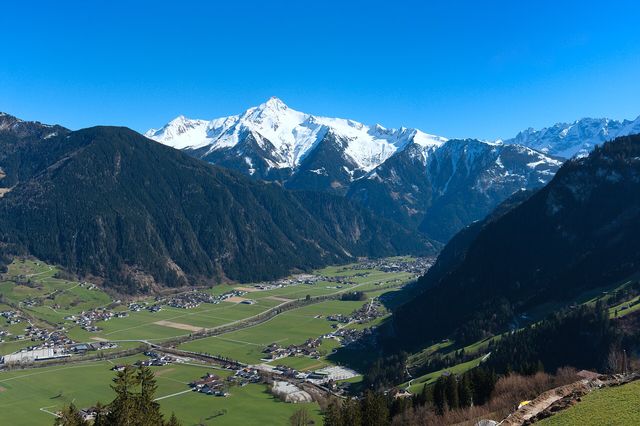
Pass-Thurn: Broad, High-Mountain Skiing Above the Valley
Pass-Thurn combines a substantial vertical range with a piste layout weighted towards accessible blue and green terrain.

Pass-Thurn sits on a broad mountain saddle above the valley, with skiing spread across open alpine slopes and gentler land lower down. Its setting gives the resort a distinctly high-mountain character without making the terrain feel exclusively severe: the landscape moves from wooded approaches towards more exposed upper slopes, while the surrounding settlement remains part of the compact, ski-focused atmosphere. It is a place defined less by a single dramatic peak than by the scale of its descent and the variety of terrain arranged along the mountain.
Bezplatné upozornenia na sneh
Vyber si stredisko. Dostaneš e-mail zadarmo, keď sa predpovedá výdatné sneženie. Odhlásiť sa môžeš kedykoľvek.
The mapped network rises from 840 metres to 1,972 metres, giving Pass-Thurn a measured vertical drop of 1,132 metres. That is in the top quarter of European resorts for vertical drop, a meaningful strength for skiers who like to link long descents and change scenery over the course of a run. The OpenStreetMap coverage supplied through OpenSkiMap maps 36 kilometres of piste across 86 runs; these are mapped figures, not an operator's published totals. Eleven mapped lifts serve the village terrain, including two gondolas, five chair lifts, one T-bar and three magic carpets.
The piste balance is especially clear. Blue and green terrain accounts for 59% of the mapped network, or 21.3 kilometres when the supplied easy and novice figures are combined, while red terrain contributes 11.9 kilometres. Black terrain accounts for 2.4 kilometres, with a further 0.3 kilometres classified as other. In practical terms, the measured layout favoured beginners and developing intermediates: there was ample room to build confidence on easier pistes, while red runs offered a step up for stronger skiers. Advanced skiers had less mapped mileage to work with than those groups.
The climate record described December to March at 1,383 metres over 15 winters. It recorded 265 centimetres of winter snow and 41 snow days, with the strongest half-month falling in the first half of January at 45 centimetres; the recorded minimum temperature was -7.4°C and the mid-winter maximum was 2.1°C. These figures describe past winters rather than a forecast. For the 2026/27 calendar season, the typical transferred season window ran from 15 December to 5 April, covering 111 days. Taken together, the measured terrain suited beginners, families and intermediate skiers particularly well, while the large vertical also gave stronger skiers scope for longer top-to-bottom outings.
- Top-quarter European vertical drop: 1,132 m
- Beginner-friendly mapped terrain: 59% blue or green
- Past December–March snow record: 265 cm over 15 winters
Každé číslo tu je merané Skinowom z OpenStreetMap, ERA5 a nášho vlastného katalógu; nastavenie a pozadie sú všeobecné vedomosti, nie merania.