The concierge behind the snow
How Climb turns a single weather check or booking into a living trip, meeting every skier from unconsented first-time reader to confirmed traveller with timely local offers and honest guidance, while protecting the quiet moments that earn trust.

מוצג המקור באנגלית.
In The system behind the snow, we wrote down the grammar of a coupled ski platform: forecasts establish physical reality, a skier's declared choices establish context, editorial craft helps them decide, and local partners compete to serve the parts of a trip still open. In The adversary behind the snow, we described the scientific clean room on Microsoft's European cloud that stops our decision engine, Climb, from mistaking a winter storm or bot traffic for its own brilliance.
Both pieces stayed mostly behind the curtain. This third essay is about the moment the curtain opens: the surface where Climb actually meets a skier on the web, in our iOS and Android apps, inside Skym, and in a quiet message when conditions or plans change.
We call this layer the Deal Concierge and Living Trip Bridge.
Before saying a word about how it works, it is worth stating plainly what it is not. It is not an ad-tech popup engine, not a dark-pattern urgency banner, and not a trick to interrupt a reader who only came to check tomorrow's freezing level.
The real failure on most weather and travel sites is much simpler: context blindness. A first-time visitor glancing at snow depth in Zermatt, a returning skier comparing two February weeks in Sölden, and a family who just booked an apartment in Val Thorens and still need skis and an airport transfer are all shown the same static slot, or chased by ads for the chalet they already paid for yesterday.
"A good mountain concierge never shouts over a forecast, respects what a skier has already settled, and never mistakes an accidental tap for value. It earns its keep only when a skier gets genuine help at the right moment and a local partner fills real capacity."
Why honesty is the only durable math on a mountain

Travel monetization usually slips into one of two bad habits. Either a site turns into a noisy marketplace where every pixel fights for a click and forecasts soften toward whoever pays the highest commission, or a team stays so allergic to commerce that a skier who genuinely needs ski hire, a valley stay, or a transfer from Geneva has to leave the product and start over on a generic aggregator that knows nothing about altitude, snowpack, or resort geography.
Both extremes fail the same two people: the skier and the local partner.
A ski shop in the French Alps or an independent transfer operator in Tyrol does not benefit from ten thousand clicks sent by readers who have no intention of travelling that week. They benefit when a real skier, actively shaping a trip to their valley, sees a clear, honest offer at the moment that piece of the trip is open. And a skier does not resent a helpful recommendation; they resent being misled, intruded upon, or interrupted while trying to read a storm outlook.
To state our commercial objective plainly: once consent and skier-value checks pass, Climb's ranking weighs expected partner commission alongside contextual relevance and an explicit annoyance cost. That is a straightforward business design. Our console tracks bookings and commission, while the rules around the ranker keep skier utility and local partner fit ahead of short-term extraction.
Before writing a single scoring function for the Deal Concierge, we encoded five structural rules and automated tests around them:
1. Weather truth stays strictly above commerce. Snowfall, freezing levels, wind exposure, and lift-outlook physics take zero input from partner bids, stock levels, or offer revenue. A bleak forecast stays bleak. 2. Commercial placements carry visible partner disclosure. Skiers see plainly when an option is a partner offer where Skinow may earn a commission across web, apps, email, and promotional push, localized where supported with a clear English fallback. 3. Within the same category and resort, commission never outranks a better match for the skier. Peer commercial offers pass a skier-value dominance check and commission-equalisation guard so a higher payout to Skinow cannot push a weaker peer ahead of an equal-or-better option for the skier. 4. Climb never narrates what it inferred. You will never see copy along the lines of "We noticed you looked at Chamonix three times this week." Good service acts on context quietly; it does not flaunt a dossier. 5. Declared choices outrank guesses, and silence is always valid. When a skier states their dates, destination, or refusal, that explicit word overrides inferred signals immediately.
The Four-Tier Intent Ladder: meeting everyone without violating consent
A common myth in product design claims you face a binary choice: either track every visitor aggressively so personalization works, or leave unconsented visitors with an empty, unhelpful page.
We rejected that trade-off. In Europe and across the world, privacy compliance is not a legal footnote to patch after launch; it is an architectural boundary enforced in code. Climb's Deal Concierge therefore runs on a Four-Tier Intent Ladder split across a hard, fail-closed consent boundary.
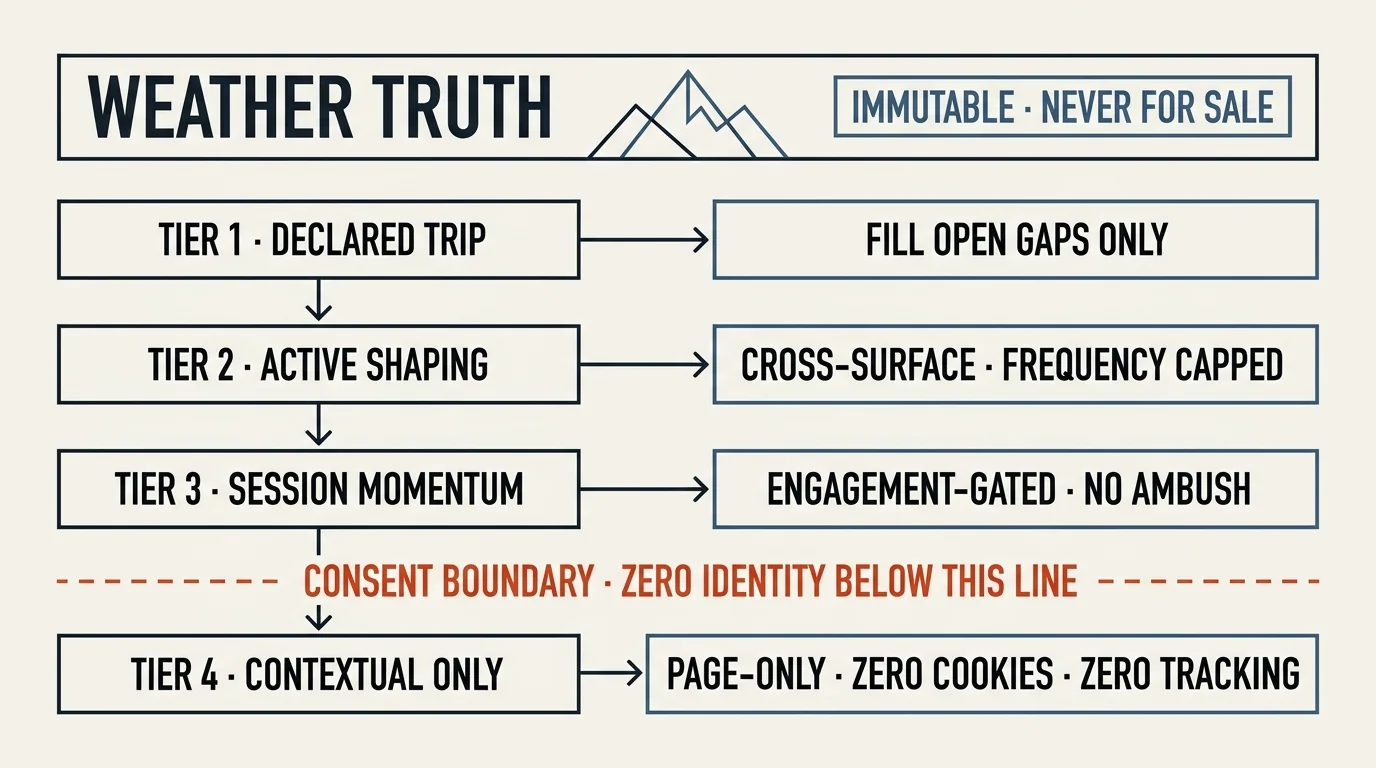
Tier 1 · Declared Trip with a Confirmed Leg
At the top of the ladder sit signed-in skiers whose Living Trip Report already records a confirmed leg, such as accommodation or gear booked through a partner. Declared context is the cleanest signal in travel. Tier 1 boosts the open gaps still needed around that trip (ski hire, airport transfers, connectivity) alongside per-offer state locks so attention stays focused on what remains unfinished.
Tier 2 · Active Trip Shaping
One rung down sit signed-in skiers who have shared explicit signals: saved favourites, declared trip dates, or active trip reports. Account offer state and dismiss memory carry across web, iOS, Android, and Skym, paired with client-side display limits so a dismissed offer does not immediately follow you to another device.
Tier 3 · In-Session Momentum
Consented returning visitors or active browsers whose stage, page type, or page count shows genuine exploration sit on Tier 3. On the web, a separate client-side engagement gate waits for real reading (scroll depth and dwell time) before displaying a single relevant step, rather than ambushing someone the moment a forecast loads.
Tier 4 · Zero-Cookie Contextual Offer
Below the vermilion consent boundary sit visitors in regions requiring consent who have not yet answered the cookie card, or who declined recording. They are not cut off from useful local help, and the concierge does not build a profile to serve it.
When recording is disallowed, the offer resolver strips account and visitor identifiers, sets zero cookies, and computes one contextual suggestion solely from the public page open right now (resort, region, language, and conditions). Browser-local `sessionStorage` remembers tab-level dismissals so a closed card stays closed while you read, while anonymous aggregate offer events and IP-keyed rate limits protect service reliability, with zero cross-session profiling and strict exclusion from person-level holdout cohorts. (Skinow's broader site-level privacy policy, including pre-answer paid-click records and Google's cookieless consent-mode pings, is documented transparently on /privacy.)
The Living Trip Bridge: why a confirmation email is the worst place to end a trip

Watch what happens on a typical booking site the instant you reserve a chalet or a pair of rental skis. A confirmation email lands in your inbox. A partner dashboard ticks up by one. And the product immediately develops amnesia, still showing hotel banners for the town you just booked while leaving you to juggle transfer times, rental pickup, and snow forecasts across six browser tabs.
Climb's Living Trip Bridge connects eligible confirmed partner bookings directly into a Living Trip Report inside Skym.
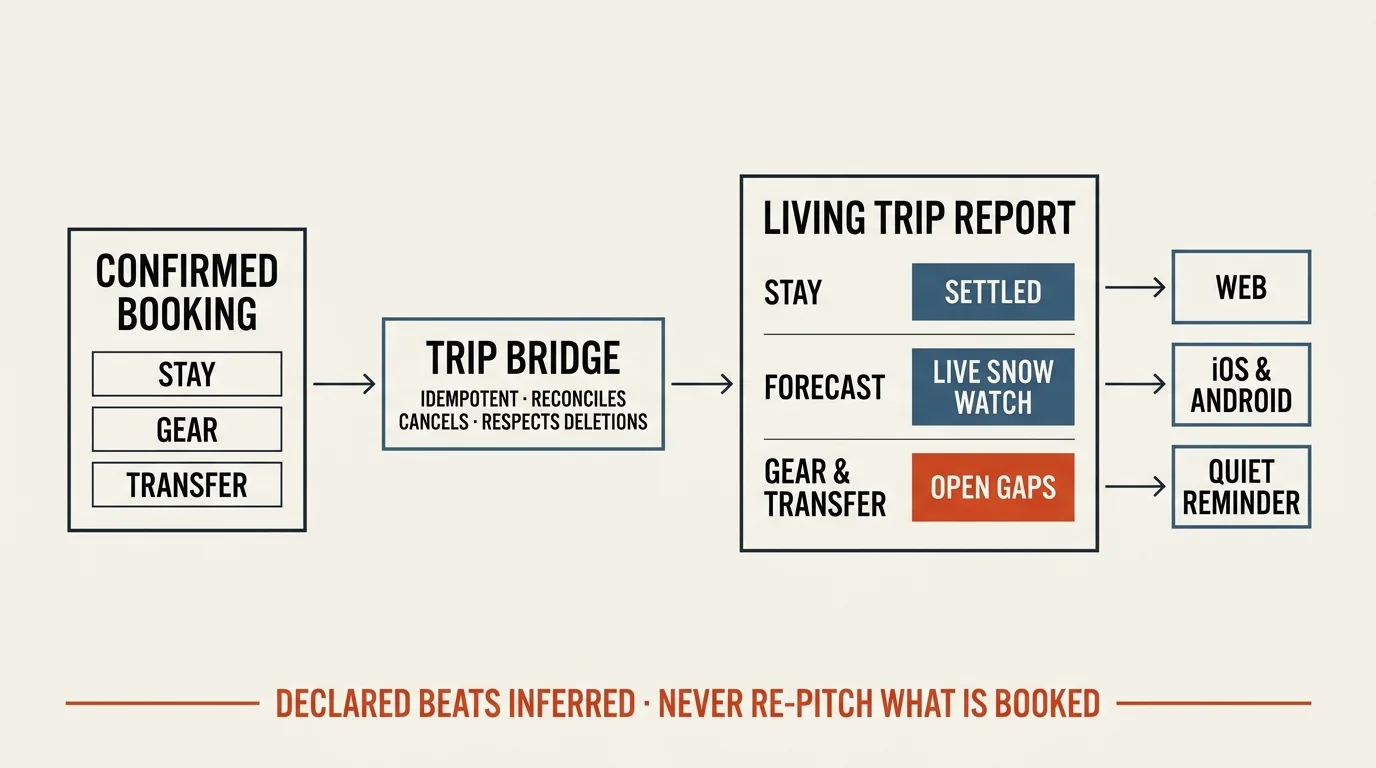
Follow an illustrative journey to see how the machinery behaves (constructed solely to explain the mechanics, not a real skier's record):
1. A signed-in skier with recording enabled compares snow reliability across two Austrian valleys, reads a guide on getting there, and books accommodation through a partner. 2. When the confirmed booking arrives and matches the account deterministically (with a validated resort for a new report), the Trip Bridge links it to their canonical Living Trip Report. It augments an existing report for that resort and overlapping dates if one exists, or seeds a clean new report with the destination, available dates, and service checklist. 3. Inside Skym, Stay flips to settled, beside live snow conditions for their resort and dates. Attention naturally turns to the pieces still open: ski hire near the valley lift, airport transfer timing, and practical trip preparation. 4. Where a booking cannot be matched deterministically to an account, Climb never guesses; it leaves the report untouched or invites the skier to confirm cleanly.
The real engineering craft in a trip bridge is not the happy path; it is the unglamorous failure modes:
- Strict idempotency: Partner feeds re-send, restate, and batch-sync confirmation rows continuously. Every bridged booking carries an atomic claim so a replayed webhook never spawns a duplicate trip report, a second Skym turn, or a repeated receipt email.
- Cancellation reconciliation: Plans change. If a booking is later cancelled or refunded in the partner ledger, the bridge marks the affected trip leg stale whenever it has no other active backing, rather than treating a cancelled chalet as settled.
- Deletion respect: If a skier deletes their Living Trip Report, the bridge stamps that processed booking so partner webhook replays never resurrect the report the skier chose to remove.
Edge-pure snow pages and quiet timing: keeping commerce off the forecast path
Anyone who has wired real-time personalization into a high-traffic content site knows the trap waiting behind it. Personalize server-rendered HTML on every request and your edge cache collapses. Forecast pages wait on origin round trips, skiers on mountain 4G stare at a blank screen, and one stray `Set-Cookie` header busts CDN hit rates across regions.
We refused to trade forecast speed or edge cache purity for commerce.
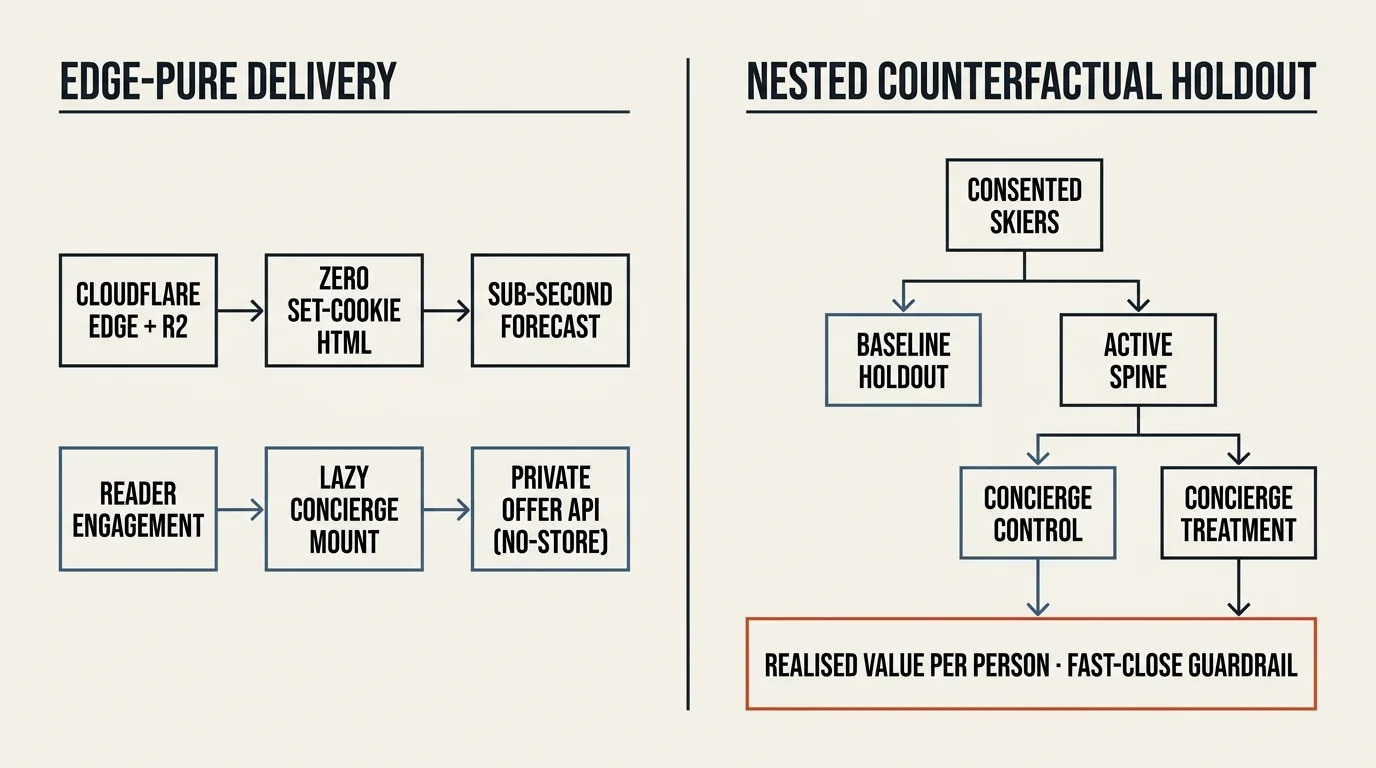
Skinow serves public forecast documents across Europe (`skinow.co`), North America (`skinow.us`), and Oceania (`skinow.au`) from edge-cached regional HTML snapshots (falling back cleanly to origin on misses) that strictly reject `Set-Cookie` headers on cacheable pages.
The Deal Concierge stays completely outside that critical path:
- Zero personalized SSR markup: Forecast HTML contains no user-specific offer code. Controlled by a dedicated web build flag, the client concierge mounts lazily only after the reader engages (dwell or scroll), never blocking initial render and stepping aside whenever a skier is actively interacting with Skym.
- Strict cache isolation: When the concierge requests an eligible offer, it calls a thin, strictly `private, no-store` API endpoint returning a compact signed offer token, leaving public CDN caching untouched.
- Shared contract across web, iOS, and Android: Our web clients and newest native builds speak the same API contract, combining active resort context, shared server offer state, privacy posture, and client-side display limits.
- Separate controls for receipts vs promotions: Factual booking receipts (which can pair a Skym trip update with a confirmation email or push) are deduplicated per booking, completely separate from promotional offers, which run under independent weekly per-channel caps and strict consent gates.
Measuring incremental value, and putting annoyance inside the objective
If Part II (The adversary behind the snow) taught us one permanent habit, it is this: never trust an adaptive engine that grades itself on vanity clicks.
An offer widget can easily inflate raw click-through rates by appearing larger, louder, and earlier, while quietly training skiers to resent the site and creating zero incremental trips. Four mechanisms inside Climb keep the Deal Concierge accountable:
1. Nested Counterfactual Holdouts: Climb maintains a permanent baseline counterfactual holdout across eligible skiers. Inside the active baseline arm sits a second, nested holdout of identified skiers who receive no concierge nudges. Over a rolling evaluation window, our console compares non-cancelled, non-estimated commission outcomes across qualifying subjects in Concierge treatment versus Concierge control, enforcing a strict minimum sample-size floor before displaying any lift figure. Attributed revenue is shown separately as a diagnostic, and unconsented Tier-4 contextual sessions stay strictly quarantined from person-level lift. 2. Fast-Close and Dismiss Guardrails: Click-through rate only sees people who tapped; it is blind to everyone who closed a card in annoyance seconds after it rendered. Client-rendered impressions, dismissals, and fast-closes feed directly into a nightly contextual bandit rollup that automatically suppresses irritating `(offer, context)` arms and flags them visibly in our internal control console. 3. Signed Attribution Without Leaking Accounts: Served offers carry short-lived cryptographic binding tokens tying eligible clicks to partner revenue outcomes without spraying personal account identifiers across third-party redirect URLs. 4. Reversible Control Plane & Planned Clean-Room Replay: Every surface (the offer engine, the web build flag, the Living Trip Bridge, email, and push) sits behind an independently reversible switch in Climb's control plane, deployed dark first and verified in shadow mode before going live. As a planned next step once real live outcomes accumulate, strictly aggregated, de-identified logs can cross our one-way, zero-PII valve into Microsoft's European cloud clean room (described in Part II) for offline counterfactual policy replay before any new ranking weights touch live skiers.
The part that stays inside
Across all three essays in this series (The system behind the snow, The adversary behind the snow, and now The concierge behind the snow), our boundary between openness and craft stays the same.
The principles belong in daylight: weather truth is never for sale; commercial placements are visibly labelled; within peer category offers, commission never outranks a better match for the skier; declared choices beat guesses; privacy boundaries are enforced in code; annoyance counts against every offer; and incremental lift is tested against a permanent nested holdout rather than assumed from a lucky storm.
The exact ranking weights, contextual features, bandit priors, cooldown durations, suppression thresholds, partner commercial terms, and attribution windows stay inside Skinow. They are the quiet craft between the diagrams.
If we built this right, nobody using Skinow will stop mid-scroll to admire our decision architecture. A skier will simply check a forecast, see a local option that genuinely fits the piece of their trip still open, find their confirmed chalet waiting in Skym beside live snow conditions, and feel like someone who knows the valley had their back. And down in that valley, a local ski shop, transfer driver, or host will welcome a traveller who actually needed them.
That is what Climb is for.
About the figures & colophon
All architectural plates, illustrative journeys, and conceptual descriptions in this monograph explain the design principles and safety boundaries of Climb's Deal Concierge and Living Trip Bridge. None discloses proprietary Skinow production metrics, live conversion rates, partner commission structures, internal cooldown settings, or real reader records. No personal skier data or confidential partner terms cross into any offline cloud evaluation environment.