Our snow alerts now wait for the weather models to agree
In early October some of our snow alerts promised far more snow than fell. What went wrong, and the three changes that now stand between one wet model run and your inbox.
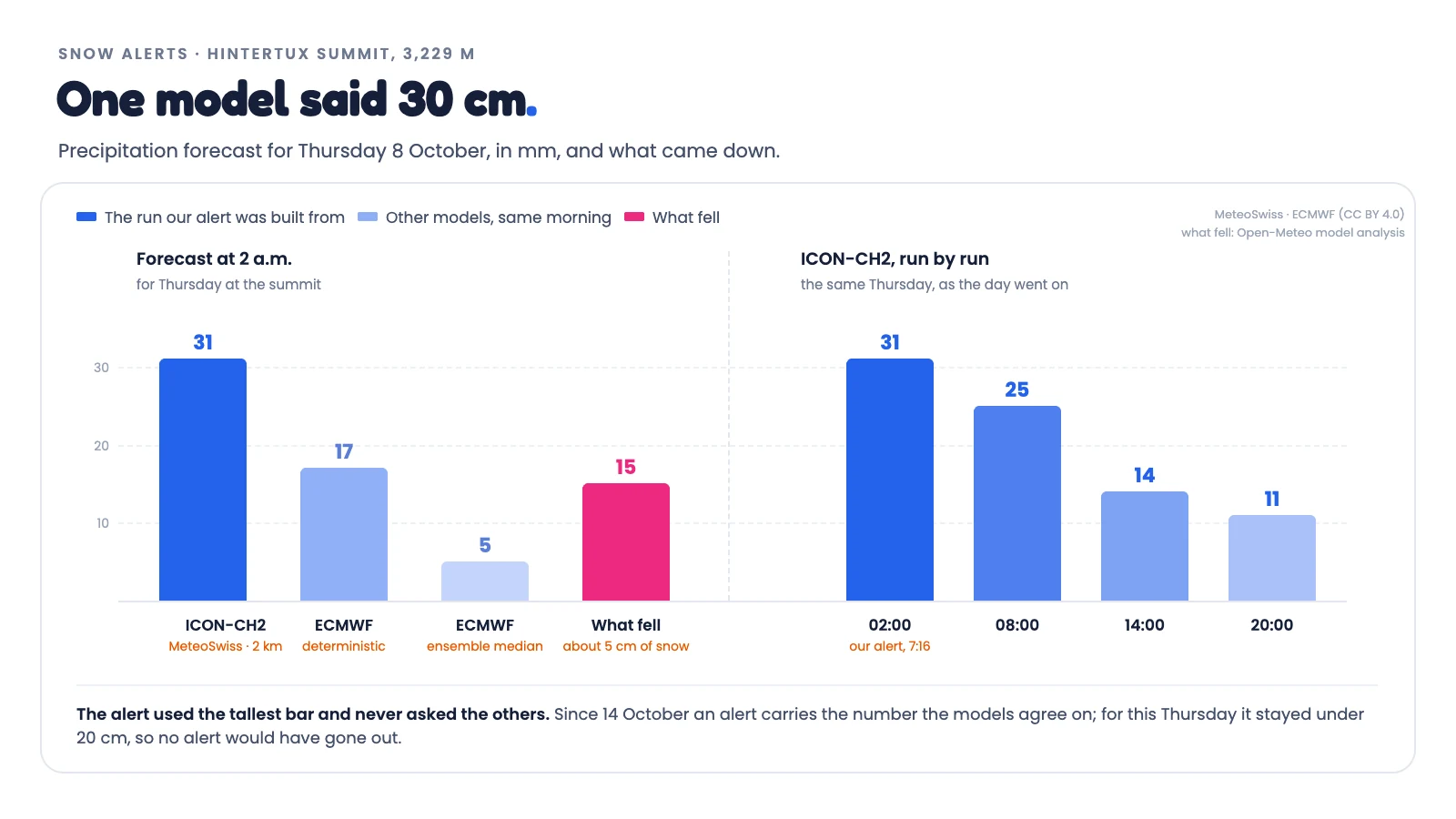
On 7 October our alerts told skiers in Italy, Austria and Switzerland to expect an early dump: 30 cm at the top of Hintertux, 48 cm at Cervinia and Zermatt. Far less fell. By the weather models' own analysis afterwards, it was about 5 cm at Hintertux and 8 at Cervinia. A reader wrote back to ask whether we had looked at our own website, which by then showed a much smaller number. The point was fair, and it is the reason for this post.
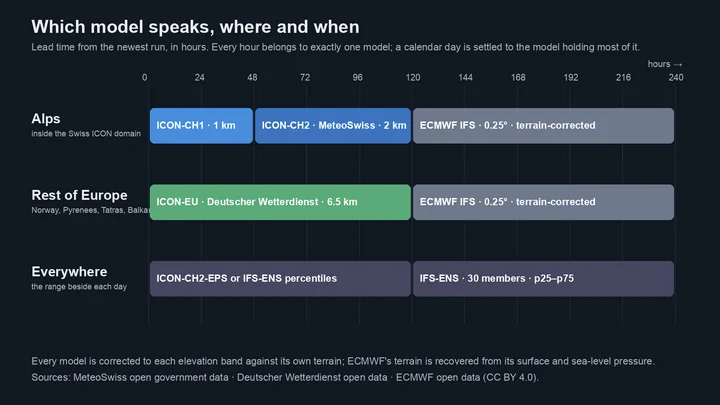
What went wrong. Every Skinow forecast is built from several weather models: MeteoSwiss's ICON-CH1 and ICON-CH2, which see the Alps in one- and two-kilometre detail, the German weather service's ICON-EU, and ECMWF's deterministic run and ensemble. For the page we take the finest model, hour by hour. On the morning of 7 October that model, ICON-CH2, expected about 31 mm of precipitation on Hintertux's summit for the Thursday, most of it as snow. ECMWF expected about 17 mm, and its ensemble median about 5. Our alerts never asked the other models. The snow line also sat almost exactly at the summit, around 3,200 m, so a small shift was enough to turn snow into rain. The later runs halved the amount within the same day. The website followed every run; an email cannot change once it has been sent.
What we changed. Since 14 October:
- An alert carries the number the models agree on. It is the lowest of four figures: the median of all the models, the forecast on our page, the best ICON figure and the best ECMWF figure. An alert goes only when that number reaches your level, so it never promises more than the page shows, or more than either family of models supports.
- A snow line at the summit waits. When the freezing level during the storm is less than 300 m below the top, or above it, the alert waits for the next run of the model carrying the storm.
- A forecast that falls apart is corrected. If the agreed number halves after an alert, or falls below your own level after dropping by at least a fifth, you get one short correction before the snow is due.
What the new rules would have done on 7 October. We replayed those alerts with the model runs that were available at the time. 54 of the 66 resorts would have stayed quiet, every Austrian one among them. The other 12 would have gone out with lower numbers (Cervinia 22 cm instead of 48), and each would have been corrected before the snow.
What they cannot do. When every model agrees and the weather does something else, agreement does not help. At Cervinia all of them expected about 22 cm, and roughly 8 fell. The correction is there for those cases, and every alert is now checked against what actually fell, day by day.
If an alert of ours ever reads wrong to you, reply to it. This change started with one such reply.